


Romantic trip to Georgia
The Ultimate 6 Days Romantic Getaway in Georgia – Embark on a dream escape through Georgia’s most enchanting destinations. Start in Tbilisi, where you’ll explore ancient sites, savor authentic Georgian cuisine. As evening falls, experience the city’s vibrant nightlife for a perfect end to your day. Next, fall in love all over again in Sighnaghi, the “City of Love,” with stunning views of the Caucasus Mountains and Alazani Valley. Visit the sacred Bodbe Convent, enjoy a cozy dinner with a view, and let the serene atmosphere sweep you off your feet. In Batumi, enjoy romantic strolls along the Black Sea, explore the iconic Ali and Nino Sculpture, and indulge in local flavors. Then, relax at the breathtaking Makhuntseti Waterfall before ending the day with a magical dolphin show. Wrap up your unforgettable journey with a scenic drive back to Tbilisi, with an optional stop at the beautiful Martvili Canyons. Let us create a journey with perfect blend of romance, adventure, and memories that will last forever!
includes:
3 nights in Tbilisi hotel with breakfast;
3 nights in Batumi apart hotel without breakfast;
Entrance tickets according to the itinerary;
Transportation and guide service according to itinerary.
Category: City
day 1
Walking tour:
Metekhi church;
Constructed in XIII c., The Metekhi Church (also known as The Metekhi church of the Nativity of the Mother of God) is not just a place of religious worship but a historical landmark that stands as a testament to the enduring Georgian spirit. The site offers stunning panoramic views of the old Tbilisi and the river Kura (Mtkvari). The contrast between the church’s serene, historic setting and the bustling streets—filled with colorful markets, lively cafes, and a mix of modern and traditional architecture—captures the dynamic spirit of Tbilisi in all its glory.Top of Form
Meidan Bazar;
Hidden beneath Meidan Square in old Tbilisi, Meidan Bazaar is a charming underground market offering a wide range of traditional Georgian goods. Visitors can explore historic trade tunnel to find local wines, spices, handicrafts, and souvenirs. Meidan Bazaar reflects role of Tbilisi as a key stop on ancient trade routes, making it a must-visit spot for both shopping and experiencing Georgian culture.
Bath house district;
The Bathhouse District in Old Tbilisi, known as Abanotubani, is renowned for its historic sulfur springs and distinctive brick domes. This area deeply blends history with relaxation. Beneath its iconic brick domes, natural sulfur springs bubble up in Tbilisi Bath houses, offering soothing, therapeutic waters that have drawn visitors for centuries. Services include soothing massages and pilling (exfoliation), where attendants scrub away dead skin, leaving it refreshed. Many bathhouses also feature steam rooms and hot stone areas for added relaxation. The experience is often complemented with beverages, making it a truly rejuvenating and culturally rich experience.
Legvtakhevi and waterfall;
Leghvtakhevi is a historic district in Tbilisi, nestled in a narrow gorge through which a small river – Tsavkistskali flows. The area is renowned for its picturesque 22-meter-high waterfall, offering a refreshing and peaceful space right in the middle of the bustling old city.
Tbilisi Juma Mosque, Tbilisi synagogue, Armenian Cathedral of Saint George or Catholic church (on request only);
Built in the 19th century, Tbilisi’s Juma Mosque is an architectural marvel that blends Neo-Gothic and Islamic design elements. Uniquely, it serves as a shared space for both Sunni and Shiite Muslims, making it one of the few mosques in the world where members of both branches of Islam pray together in harmony. Juma Mosque symbolizes Georgia’s rich tradition of religious tolerance and unity.
Catholic Cathedral of the Assumption of the Virgin
Built in the 19th century, the Catholic Church showcases a harmonious blend of Baroque and Neo-Gothic architectural elements. In the 20th century, it underwent restoration and was rededicated to the Assumption of Virgin Mary. Today, the sanctuary features striking contemporary frescoes. The church continues to serve as the spiritual heart for the Catholic community, offering a place of worship and spiritual reflection for believers.
Peace Bridge;
Designed by Italian architect Michele De Lucchi in 2010, the Peace Bridge in Tbilisi connects the modern and historic districts of Tbilisi. In total, 48,000 LEDs and 240 sensors light up the bridge, making it a stunning visual landmark. Every hour, a Morse code message is transmitted across the parapets, symbolizing “life and peace between people,” as envisioned by lighting designer Philippe Martinaud. The Peace Bridge is a symbol of unity across cultures and generations.
Cable ride;
The cable car connects Rike park to Narikala. It was designed and built by the Italian company LEITNER. The entire cable car system meets international standards and European safety norms. Length of the cable line is 500 meters and features seven gondolas with panoramic view. Strategic location of the cable route makes it one of the favorite attractions among the locals as well as the tourists.
Narikala Fortress
Early evidence of Narikala Fortress dates back from the 4th century. Narikala Fortress has witnessed the evolution of Tbilisi through its early years. It has endured the city’s many challenges and wars, standing as a resilient symbol of Tbilisi’s turbulent history. Although now Narikala Fortress remains one of the city’s main attractions, proudly overlooking the old district of the capital.
Mother of Georgia monument
The Kartlis Deda (Mother of Georgia) monument, created by renowned Georgian sculptor Elguja Amashukeli, stands as a striking 20-meter-tall aluminum figure. Dressed in traditional Georgian attire, the statue holds a glass of wine in one hand, symbolizing the country’s hospitality to friendly visitors, and a sword – in the other, representing its readiness to defend against adversaries. This monument embodies the aspects of Georgian character: warmth and hospitality, combined with strength and vigilance in protecting their land.
Visit Gardenia Tbilisi (on request).
Gardenia Shevardnadze
Step into Gardenia Shevardnadze, where nature and creativity come to life! This enchanting garden is a peaceful retreat filled with lush greenery, charming walkways, and unique floral displays. It is the place where you can wander through breathtaking gardens and discover rare plants; enjoy a cozy café experience surrounded by nature; find handcrafted souvenirs and beautiful floral gifts. Whether you’re a nature lover, a photography enthusiast, or simply looking for a peaceful escape, Gardenia Shevardnadze is a must-visit in Tbilisi!
Welcoming Dinner in a Restaurant with the dance and singing program (Optional and booking in advance is required).
day 2
Departure from Tbilisi to the most east part of the country - Kakheti Region;
Kakheti region is the east part of the country, where the most fertile Alazani Valley is located. The region is famous for its agriculture, moderate climate, national parks, historical sites, ancient cities, medieval fortresses, authentic cuisine and 8 thousand years old wine making traditions.
Visit Bodbe Convent;
Bodbe Convent is one of the most vital religious sites in Georgia, pilgrimage destinations for all Christians as it is the burial site of Saint Nino – IV century saint who convinced Georgian king and queen to declare Christianity as a state religion. IX century church is surrounded by beautiful garden, overlooking Alazani Valley and ever snowy Caucasian mountains.
Visit Sighnaghi – the city of love
A small town in Georgia named Sighnaghi is a great place with its romantic atmosphere, architecture and 24/7 working wedding venue. “Georgian Las Vegas” – Sighnaghi is favorite destination for couples and newlyweds as in the center of the town there is Wedding hall that works 24/7. Romantic boutique style hotels, with swimming pools, cozy restaurants overlooking Alazani Valley and Caucasian mountains where you can try authentic Georgian cuisine.
Explore Sighnaghi fortress;
Sometimes referred as “The Great Wall of Georgia” – Sighnaghi Fortress is constructed in XVIII century and stretches over 4 kilometers with 23 watch towers. Currently, Sighnaghi fortress is the most preserved fortifications in the country.
Lunch in Sighnaghi on request;
The restaurants of Sighnaghi offer delicious and authentic traditional food, equipped with terraces overlooking the Caucasian Mountains and Alazani Valley.
Georgian wine degustation (on request);
Georgian wine making technology is 8 thousand years old and considered oldest in the world. Visit local wine cellars or big factories and take opportunity to taste authentic Georgian wines.
Hotel Ambassador in Kachreti and equestrian club (on request; booking in advance);
If you love horses and enjoy horse riding than it’s time to visit equestrian club of Kachreti Ambassadori hotel. Equestrian Club offers:
- A Stable for horses
- Horse riding outdoor arena
- Horse riding lessons
- Equestrian sports competitions
East Point Shopping & Entertainment City (optional)
in Tbilisi is the largest open-air shopping mall in Georgia, offering a mix of retail, dining, and entertainment. Located just 15 minutes from the city center, it features international and local brands, a cinema, a bowling alley, and family-friendly attractions. With its modern design and spacious layout, East Point provides a relaxed shopping experience away from the busy streets of Tbilisi, making it a great stop for tourists looking to shop, dine, or unwind.
Return to Tbilisi.
day 3
Travel to Batumi
Accommodation in Apart hotel with the view of the Black Sea.
day 4
Batumi Port;
Since the Roman times, Batumi Port has been a key point in the maritime network. From 1878 to 1885, the status of “Porto-Franco” (freeport) played a significant role in the development of the city not only the port. The city and port expanded rapidly, primarily driven by the transport of oil from Baku, which spurred improvements in infrastructure. Prominent figures like the Nobel family, Rothschild, Samuel (founder of “Shell”), and Mantashev contributed to the port’s growth and modernization. Today, Batumi Port continues to serve as an important link in the Eurasian transport corridor, connecting Europe and Asia and supporting various cargo and passenger needs.
Statue of Ali and Nino;
The monument – Ali and Nino – dedicated to Caucasian “Romeo and Juliet” was inspired by the 1937 novel of the same name by Kurban Said, stands proudly on seashore of Batumi. This striking 8-meter-high sculpture, created by Georgian artist Tamar Kvesitadze, features two transparent steel figures that slowly move through each other every 10 minutes, symbolizing the eternal struggle and tragic love story between Azerbaijani Muslim – Ali and Georgian Christian – Nino. Their heart-wrenching story reflects a timeless message of love transcending nationality and belief.
Statue "Me, you and Batumi";
The sculpture “Me, You and Batumi” by Irakli Tsuladze celebrates deep-rooted coffee culture in Batumi. This enchanting monument features a man and a woman seated at a café table, frozen in the intimate ritual of sharing coffee. The artwork has quickly become a cherished landmark, captivating visitors with its elegant portrayal of Batumi’s vibrant social life and the timeless joy of a coffee shared.
The Alphabetic Tower;
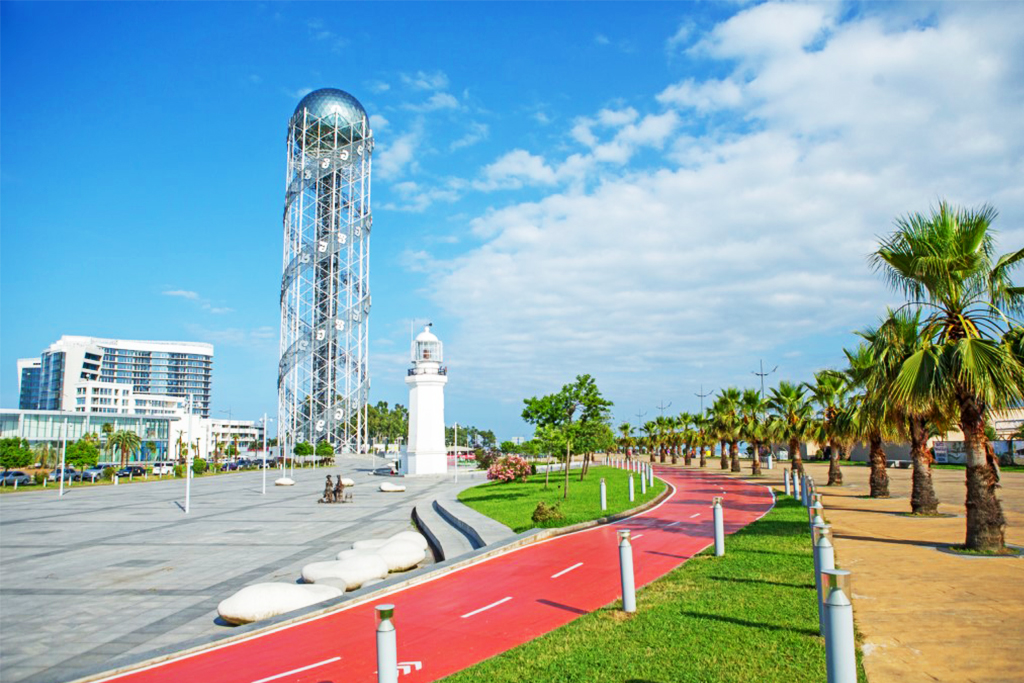
The Alphabetic Tower, a striking creation by Spanish architects Alberto Domingo Cabo and Carlos Lázaro, was completed in 2010. Standing at an impressive 130 meters, this architectural marvel symbolizes the rich heritage of the Georgian alphabet and its people. Its design mirrors the double helix of DNA, with two ascending helix bands that showcase 33 Georgian letters, each measuring 4 meters in height. At the tower’s heart, an exposed elevator shaft ascends to its crowning monumental silver sphere that caps the structure offering panoramic view of the city. At the very pinnacle of the sphere, a stylish café awaits, offering caffeinated beverages. Whether it’s the invigorating drinks or the mesmerizing scenery, this high-altitude café-restaurant promises a truly memorable escape above the city.
Batumi lighthouse;
The Batumi Lighthouse, with over 150 years of history, stands as a proud symbol of the city’s maritime legacy. First lit in the 1890s, its beam reaches 14 nautical miles, guiding ships to safety. Designed by French engineers in 1882, its striking stone structure once housed the Batumi Meteorological Station and emergency rowboats. Though the outbuildings are gone, the lighthouse remains a vital navigational tool and a testament to Batumi’s nautical past, making it a must-see for history and sea lovers alike.
Batumi Boulevard and Michael D’Alphonse;
Stretch along 7-kilometer of the seaside, Batumi Boulevard is a lively destination filled with beach bars, café-lounges, restaurants and vibrant dancing fountains. The boulevard is not just a leisure spot but a showcase of unique vegetation, fascinating sculptures, architectural monuments and amusement rides for children. With over a century of history, its development began in 1881, led by French gardener Mikheil d’Alphonse, affectionately called the “Kind Genie of Batumi Seaside.” Batumi Boulevard is where nature, art, and history come together in perfect harmony, offering an unforgettable experience for visitors of all ages, whether you’re strolling through its lush landscapes, admiring the sculptures, or enjoying the lively atmosphere by the sea.
Batumi Drama theater;
Batumi Drama Theatre, designed by I. Teplitsky in 1952, stands as a cultural landmark in the center of old Batumi. Since 1959, it proudly bears the name of Ilia Chavchavadze, one of Georgia’s most revered literary figures. With seating for 480 spectators, the theatre invites guests to immerse themselves in captivating performances. Beyond the stage, the theatre houses a fascinating museum that showcases its rich history, including archival materials, rare photo-video-audio recordings and detailed rehearsal diaries. Batumi Drama Theatre a place where the spirit of Georgian art and the legacy of performance come to life.
Statue of Neptune;
The monumental Neptune Fountain stands in front of Batumi’s Drama Theatre, featuring a gilded statue of Neptune on a towering pedestal. With a commanding gesture Neptune is surrounded by four elegant mermaids. Inspired by the 16th-century fountain from Bologna (Italy), the statue of Neptune symbolizes the deep ties of Batumi to the Black Sea.
Square of Europe;
Europe Square in Batumi is a charming mix of history and modern life, known for its beautiful XIX-XX century architecture. The statue of Medea is the central monument of the square. Medea is holding the golden fleece, that symbolizes the glory and cultural significance of ancient Colchis, as the proto-Georgian state. One of the eye-catching landmarks of the square is Astronomical Clock, crafted in Germany in 2010. The clock displays not only the time but also the positions of the sun and moon, moon phases, and the time of sunrise and sunset. Europe Square is surrounded with hotels, restaurants, and cafes where visitors can relax and enjoy local and European cuisine. It is also a lively hub for events, hosting New Year celebrations, Christmas markets, concerts, and the Batumoba festival (the day of the city-Batumi), making it a vibrant part of the city’s culture.
Batumi Cathedral named after the Nativity of the Virgin Mary (on request only);
Batumi Cathedral, originally built as a Catholic church in 1903, stands as a testament to the city’s rich and diverse history. Commissioned by the prominent Zubalashvili brothers, Georgian Catholic businessmen, this religious center was designed by renowned Polish architect Aleksander Rogojski in the striking Gothic Revival style: Its towering spires and intricate details evoke a sense of grandeur and timeless beauty. During the Soviet era, the cathedral was closed and repurposed into a high-voltage laboratory, a stark contrast to its original intent. However, in 1989, this historic building found new life when it was transferred to the Georgian Orthodox Church, restoring its spiritual role and reconnecting it to Batumi’s religious and cultural heritage.
Batumi Mosque (on request only);
The Batumi Mosque, a cherished center for the city’s sizable Muslim community, stands as a living testament to Batumi’s rich historical tapestry. It was commissioned in 1866 by Aslan Beg Khimshiashvili, a Muslim Georgian nobleman. The mosque’s golden dome and white minaret stand out, contributing to Batumi’s multicultural urban environment. The entrance is adorned with carved doors featuring Georgian motifs, including vine patterns and yellow flowers. The building’s exterior is plastered and painted white, while the interior boasts colorful, detailed paintings by artists from Lazistan, reflecting the region’s artistic heritage. After being closed during the Soviet era, the Batumi Mosque underwent renovations in the 1990s, including the construction of a new minaret in 1995. Today, it continues to serve as a vital center for the Muslim spiritual and cultural activities in the city.
Batumi Catholic Church (on request only);
The Church of the Holy Spirit in Batumi is a remarkable Roman Catholic church that symbolizes both the revival of faith and the resilience of cultural heritage. Erected in the late 1990s by the Georgian architects – Oleg Pataridze and Giorgi Baghoshvili, it was consecrated in 2000, marking a significant moment in religious history of Batumi. The Church of the Holy Spirit stands as a testament to the enduring spirit of Batumi’s Catholic community. Its modern design, crafted with both reverence and innovation, reclaims and revitalizes the city’s Roman Catholic presence. The church not only enriches Batumi’s architectural landscape but also serves as a powerful symbol of religious and cultural renewal of the post-Soviet era.
Batumi Synagogue (on request only);
Designed by architect Semion Vulkovich, Batumi Synagogue was completed in 1904. The architect drew inspiration from the elegant synagogues of Amsterdam and The Hague, resulting in a building that stood as a testament to architectural beauty and cultural significance. For over two decades, the synagogue was a vibrant center for the Ashkenazi Jewish community in Batumi. However, in 1929, the Soviet government repurposed it for use by various sports organizations, shifting its role from a place of worship to a venue for athletic activities. The history of the building took a positive turn in 1993 when it was returned to the Jewish community. After undergoing restoration, it reopened as a synagogue in 1998. In 2011, the synagogue was recognized as a cultural heritage site. Today, the synagogue continues to serve small but active Jewish community of Batumi. It also draws visitors from Israel and around the world.
Armenian Church (on request only);
In 1879 the Armenian Apostolic Holy Church, known as Surb Prkich, was established in Batumi through the efforts of Priest – Konstandin Ter-Stepanyan. The original wooden structure quickly proved insufficient, prompting the construction of a new building. But due to financial challenges, construction faced significant delays and extended over a quarter of a century. In 1899, designed by Austrian architect – Robert Marfeld the new church was completed. It was constructed from durable burnt brick in the cross-domed architectural style. During the Soviet era, the church was repurposed first, as a movie rental warehouse and later, as an astrophysical observatory. After the Soviet Union collapsed, the church underwent extensive reconstruction. It was reopened and restored to its original function as a center for Armenian religious life, continuing to serve as an important place of worship for Armenian community in Batumi.
Argo cable car;
Since its installation in 2013, the ARGO cable car has welcomed over two million passengers, quickly becoming one of famous attractions of Batumi. The route stretches over 2,586 meters, ending at the scenic heights of Anuria Mountain, 256 meters above sea level. With 20 gondolas, each offering eight seats, the 15-minute ride offers more than just transportation—it provides breathtaking views of Batumi’s skyline, its vibrant port, and the endless sweep of the Black Sea. But the experience doesn’t end at the summit. Upon arrival, visitors can explore ARGO’s cultural-entertainment complex, where panoramic view and the restaurant make ARGO a perfect destination for adventure and relaxation alike.
Saint Nicholas Church;
The Greek Orthodox Church of St. Nicholas, over 150 years old, is one of captivating landmarks of Batumi. Built in 1865-1871 by local Greeks, this stunning domed church reflects the elements of Byzantine architecture. The interior of St. Nicholas Church features wall paintings from 2002, adding a modern touch to its rich past. On the western wall, a memorial stone with a Greek inscription marks its origin: “The Greek Church of St. Nicholas. Construction period is 1865-1871.” In the early 20th century, the church was gifted sacred icons by the Greeks from Khiros Island, including icons of St. Nicholas, St. George, and the Blessed Virgin Mary. Now part of the Georgian Orthodox Church, St. Nicholas invites visitors to explore its timeless charm and peaceful atmosphere, offering a unique glimpse into rich cultural and religious heritage of Batumi.
Batumi Piazza;
A vibrant gathering spot for both locals and visitors, Batumi Piazza was designed by the renowned Georgian architect Vazha Orbeladze and opened in 2009. This charming square is surrounded by a variety of hotels and restaurants, making it a lively hub in the heart of old Batumi. One of the striking features is its magnificent mosaic, created by the Georgian-Swiss designer – Natali De Pita-Amirejibi. Completed in 2010, this mosaic is one of the largest figurative marble mosaics in Europe, spanning over 106 square meters. Crafted in Abu Dhabi by Fantini Mosaic and transported to Batumi, the mosaic is made from over 88 million meticulously cut marble tiles. The mosaic beautifully captures the connection between the endless motion of the sea and ever-changing rhythm of daily life, making it a perfect symbol of vibrant seaside city – Batumi.
Coffee break at Batumi Piazza (on request) and coffee break (on request).
Botanical Garden;
Divided into nine distinct phyto-geographic sections and three beautifully maintained parks, Batumi Botanical Garden is a haven for plant enthusiasts and nature lovers alike. Just 9 km away from the center of Batumi, Botanical Garden covers over 108 hectares. Founded in 1912 by renowned geographer, botanist and explorer – Andrei Krasnov, the garden offers a rich tapestry of flora from around the world. The garden is home to an extraordinary collection of century-old trees and a stunning array of subtropical plants, including succulents, palms, roses, camellias, citrus, bamboo, magnolias, and more. Among its 1,800 species, 90 are native to the Caucasus, making it a unique window into the region’s natural heritage. Visitors can enjoy guided tours, peaceful camping and picnic areas, or even use this location as a venue for wedding ceremonies.
Boat ride at Batumi.
Step aboard a lively party boat in Batumi and set sail on an unforgettable adventure! Dance to upbeat music, sip refreshing drinks, and soak in breathtaking views of Batumi’s glittering skyline, lush green mountains, and the endless Black Sea. Feel the cool breeze as you cruise along the coast, with the chance to dive into crystal-clear waters for a refreshing swim. Whether you’re looking to relax or party under the sun, this boat ride is the perfect way to experience Batumi from a whole new perspective!
day 5
Makhuntseti waterfall;
Makhuntseti Waterfall, nestled in the scenic gorge, offers an unforgettable experience for nature lovers and adventurers alike. Located just above the charming village of Makhuntseti, at 335 meters above sea level, this breathtaking 50-meter-high water cascade tumbles into a picturesque pool, forming a mesmerizing whirlpool below. The waterfall is framed by striking natural rock formations. Visitors can enjoy the beauty of the falls from nearby restaurants or unwind in peaceful picnic spots that invite relaxation in the heart of nature. Whether you’re seeking a tranquil escape or a place to marvel at Georgia’s natural wonders, Makhuntseti Waterfall is sure to captivate your senses.
Visit Acharian Wine House (Optional and booking in advance is required);
Nestled in the scenic Adjara mountains, the Georgian restaurant at Adjarian Wine House offers an unforgettable dining experience surrounded by vineyards and breathtaking landscapes. Here, you can savor authentic Georgian cuisine, expertly paired with locally crafted wines, including the signature Chkhaveri Rosé from the “Porto Franco” collection.
With a warm and inviting atmosphere, the restaurant serves a variety of traditional dishes made from fresh, locally sourced ingredients, showcasing the rich flavors of Georgia’s culinary heritage. Whether you’re indulging in a classic Adjarian Khachapuri, enjoying a hearty Mtsvadi (grilled meat skewers), or sampling other regional specialties, each bite is a true delight.
Batumi Dolphinarium (Optional and booking in advance is required).
The Batumi Dolphinarium, originally opened in 1975, made its grand return in 2011 after a 20-year pause and has since become a beloved highlight of the seaside town. As part of the Black Sea Flora and Fauna Scientific Research Center, the dolphinarium boasts a design by renowned American companies like – TJP Engineering and RCK. It meets the highest modern standards for marine mammal care, with water recirculated every two hours, purified by ozone, and closely monitored for temperature, salinity, and PH levels. The interactive shows offer an unforgettable experience for visitors of all ages in the Batumi Dolphinarium. In response to growing demand, especially during the summer season, the dolphinarium hosts three daily shows. Its amphitheater, with a seating capacity of 887 across four sectors, provides excellent views of the performances. Accessibility is a priority, with lifts and wheelchair ramps ensuring all guests can enjoy the experience. Whether you’re a local or a visitor, the Batumi Dolphinarium offers a fun and memorable experience, making it a must-visit attraction of the city.
day 6
Return to Tbilisi;
On the way visit Martvili Canyions (optional).
Emerged from the sea million years ago, Martvili canyon has exceptional ecosystem with beautiful scenery, cascades of waterfalls, 2 bridges, 3 viewing platforms and 300 miter boat trip opportunity through the canyon.
Step into a world that emerged from the sea million years ago, where the land once claimed by the sea now reveals a stunning natural wonder – it is Martvili Canyon. As you wander through this impressive ecosystem, you’re greeted by the soothing sound of waterfalls cascading down ancient rock formations. Enjoy the views from two historic bridges, each offering a unique perspective on the canyon’s beauty. For a truly immersive experience, hop on a boat and glide through 300 meters of crystal-clear waters, surrounded by towering cliffs and vibrant greenery—seems like an adventure through time and nature!
Please, be aware: The entrance and boat trip could be restricted due to the weather conditions.
Be the first to review “Romantic trip to Georgia” Cancel reply


Reviews
There are no reviews yet.